Biotech is not like other sectors when it comes to investor presentations. The science is complex. The timelines are long. The risk profile is distinctive. And the audience, whether you’re presenting to a specialist biotech VC, a family office exploring life sciences, or a strategic pharma partner, ranges from deeply technical to frustratingly non-technical, sometimes in the same room.
We design these decks for a living, and the science is the easiest thing to get subtly wrong. So at Hype Presentations, a PhD scientist reads your whole story before a designer touches a single slide. That order matters, and it shapes everything below. Getting a biotech pitch deck right is hard. Here’s what actually works.

Know your audience before you write a word
This applies to every pitch, but it’s especially critical in biotech. A deck that works for a specialist investor who understands mechanism of action, Phase II endpoints, and QALY calculations will not work for a generalist investor who is still trying to understand the size of the problem you’re solving.
Before you structure anything, ask yourself:
- How much scientific literacy does my audience have?
- What do they most need to be convinced of?
- Are they evaluating the science, the commercial opportunity, the team, or all three?
- What questions will they definitely ask?
The answers to these questions should shape the entire structure of your deck.

Lead with the problem, not the science
This is the most common mistake in biotech decks. The founders are, understandably, excited about their science. The mechanism is elegant. The data is compelling. They want to show that immediately.
The problem is that an investor who doesn’t yet understand why this matters, at a human and commercial level, is not ready to evaluate the science. They’re still trying to orient themselves.
Lead with the clinical problem. How many people are affected? What does the current standard of care fail to deliver? What does that failure cost the patient, the healthcare system, and the market?
Once the problem is vivid and specific, the science becomes the answer to a question the investor is already asking.

Explain the science without dumbing it down
There is a middle ground between inaccessible jargon and embarrassing oversimplification, and that’s where the best biotech decks live.
The goal is to give a non-specialist enough to follow the logic, while giving a specialist enough to evaluate the claim. You can do this by:
- Using plain language for the mechanism overview before going into detail
- Visualising the biology where possible. Clear, well-designed diagrams beat bullet points every time.
- Being explicit about what you do and don’t yet know
- Leading with the clinical benefit rather than the molecular detail
He traded his pipette for a pen, and that scientific review is the difference between a deck that looks clear and one your audience can actually follow.
A helpful test: can someone with a business background understand why this approach is different and potentially better? If yes, you’re probably in the right territory.
Be honest about where you are in the pipeline
Investors have seen plenty of decks that obscure uncertainty behind confident language. It doesn’t work, and experienced investors see through it immediately.
Be clear about:
- Which stage you are at (preclinical, Phase I, II, III)
- What the key data shows and what it doesn’t yet show
- What the next milestone is and what it will prove
- What could go wrong and how you’re mitigating it
Intellectual honesty is not a weakness in biotech. It’s a trust signal.
Make the commercial case clearly
The science gets you into the room. The commercial case is what gets you the cheque.
Your deck needs to make a convincing argument that this is not just a scientifically interesting programme but a commercially viable one. That means addressing:
- Market size, but credibly. Bottom-up analysis beats top-down assertions.
- The reimbursement landscape. How does this get paid for?
- The competitive environment. What else is in development? Why is your approach better positioned?
- The business model. Are you building to partner, to commercialise independently, or to exit?
- The path to value creation. What happens after this round that makes the next round or exit viable?
The team slide matters more than you think
Biotech investors are backing the team as much as the science. Your team slide should go beyond names and credentials. It should answer: why is this the team that can actually execute?
Cover scientific credibility, yes. But also cover relevant commercial experience, regulatory track record, and any strategic advisors or board members who bring additional weight.
If there are gaps in the team, acknowledge them and explain how you’re filling them.
Use design to aid comprehension, not to impress
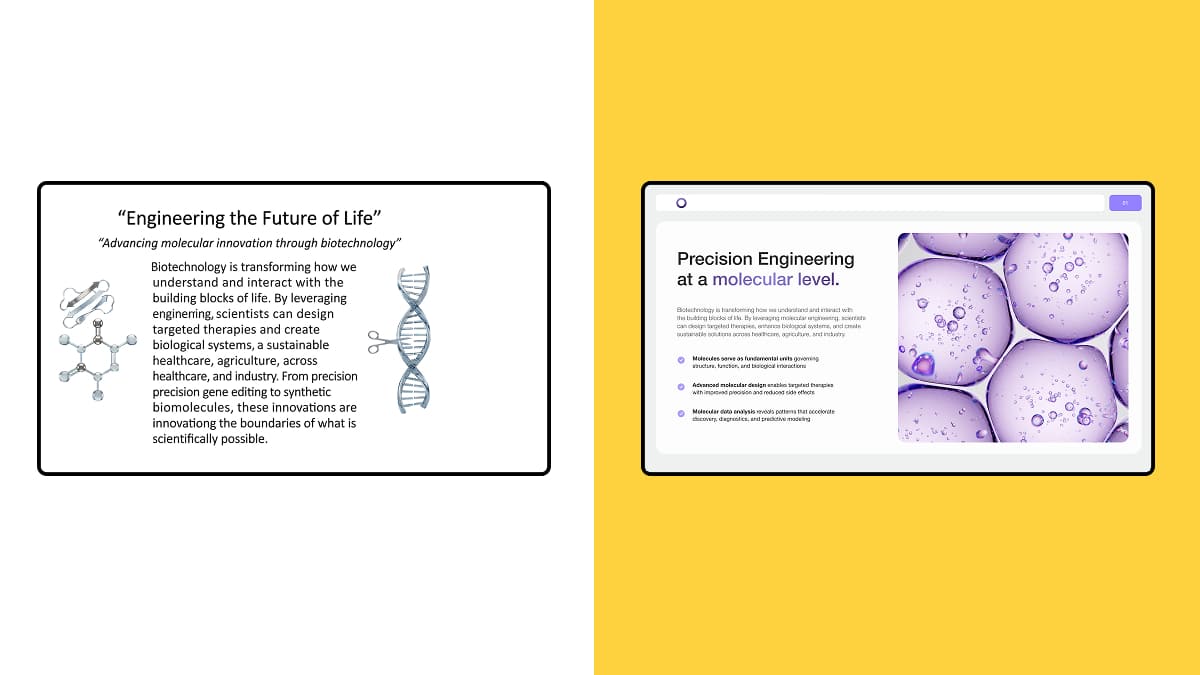
Biotech decks are often either too dense (walls of data in tiny text) or too thin (vague statements with no evidence). Neither works.
Good design in a biotech investor deck means:
- Diagrams that clarify, not decorate
- Charts that make a clear point with a descriptive headline
- Consistent structure that helps the investor navigate
- Enough white space to make the slide readable at presentation pace
- Slide titles that function as headlines, not labels
If your deck can’t be understood at the speed of a live presentation, it needs more design work.
Prepare for the questions you don’t want
The best preparation for an investor meeting is to ask yourself: what is the hardest question they could ask me, and do I have a compelling answer?
Common tough questions in biotech pitches:
- Why hasn’t anyone else done this?
- What’s your regulatory strategy?
- What happens if Phase II data is inconclusive?
- Who are you competing against in the pipeline, not just on the market?
- What does the path to commercialisation look like, specifically?
Build answers into your appendix. You don’t need them on every slide, but you need them available.
Getting professional help with your biotech pitch deck
A specialist presentation design agency should do more than make your slides look better. The good ones help you find where the story is unclear, where the commercial argument needs strengthening, and where the design is quietly working against your credibility. Some biotech teams ask us, “aren’t you just designers?” It’s a fair question, and the honest answer is no. For biotech, design is only part of the job.
At Hype Presentations we work with biotech and life sciences teams on investor decks, partner presentations and regulatory submissions. Every project runs through scientific review first, then storytelling, then design and build, so the science stays accurate while the story gets sharper. We’ve built decks for companies including Scenic Biotech, Virometix and Ceuta Healthcare, whose communications director described our team as “hugely talented and adaptable” and the work as “impeccable”. Most biotech projects take one to three weeks, and we move faster when a raise or a deadline demands it.
- Visit our biotech presentation design page
- See our pitch deck design services
FAQs
How long should a biotech pitch deck be?
Aim for 15 to 20 slides for a core investor deck, with a detailed appendix for technical and financial questions. The core deck should be presentable in 20 to 30 minutes with time for questions.
Should a biotech pitch deck include clinical data?
Yes, but selectively. Include headline data that supports your key claims. Detailed study data, methodology, and statistical analysis belong in the appendix, available for technical due diligence.
How do I explain complex science to a non-specialist investor?
Lead with the clinical problem and the patient impact before the mechanism. Use clear, well-designed diagrams rather than text descriptions. Keep the scientific detail available but don’t front-load it.
What’s the biggest mistake in biotech investor presentations?
Starting with the science rather than the problem. Investors need to care about the problem before they can evaluate the solution. Lead with the human and commercial stakes first.