Yes, it works. Around 50% of our clients are US based, and the thing they were most nervous about before starting is usually the thing they end up liking most.
If you’re a US company weighing up a global presentation design agency, you’ve probably already found the work you want. What you’re really doing now is stress-testing the logistics before someone in finance or procurement asks you to. Fair enough. So here’s the honest version: how it runs, what genuinely changes when your presentation design services partner sits 3,500 miles away, and the one objection that comes up every single time.
Working with a global presentation design agency from the US: the short answer
Presentation design is not a job that requires anyone to be in the same room, or the same country.
It runs on a clear sequence: brief, design, feedback, revise, deliver. Every stage is a handoff, not a live working session. That’s true whether your designer is in Manhattan or Manchester. The parts that actually determine whether a project goes well are the quality of the brief, the discipline of the feedback, and the craft of the team. None of those are geographic.
The parts that do change are real but small: you’ll schedule calls rather than drop by, you’ll get more written detail, and you’ll get work back overnight. Most US clients treat the last one as an upgrade.
Local is overrated, and has been for about a decade
Here’s the opinion we’ll happily defend: proximity has almost nothing to do with the quality of your deck.
Think about how a project with a local agency actually goes. You have a kick-off call on Zoom or Teams. You share a brief and a brand pack in a Google Drive folder. You get slides back as a PowerPoint file. You mark up feedback in a doc or on a call. You approve. Not one of those steps improves because the designer is 20 minutes down the road, and you almost certainly weren’t going to visit their office anyway.
We’ve had US clients tell us their previous agency was a 15-minute drive away and they never once went. What they did have was a slower turnaround, a higher rate, and a designer who treated a Series B pitch deck like a formatting job.
Location is the easiest thing to check on an agency, which is exactly why buyers over-weight it. It’s a proxy for reassurance, not a measure of quality. The things that actually predict a good outcome are harder to check: does the work in their portfolio look like the standard you need, do they push back on a weak brief, and can they explain how they’ll run the project without going vague on you.
The time zone question, and why it’s the wrong way round
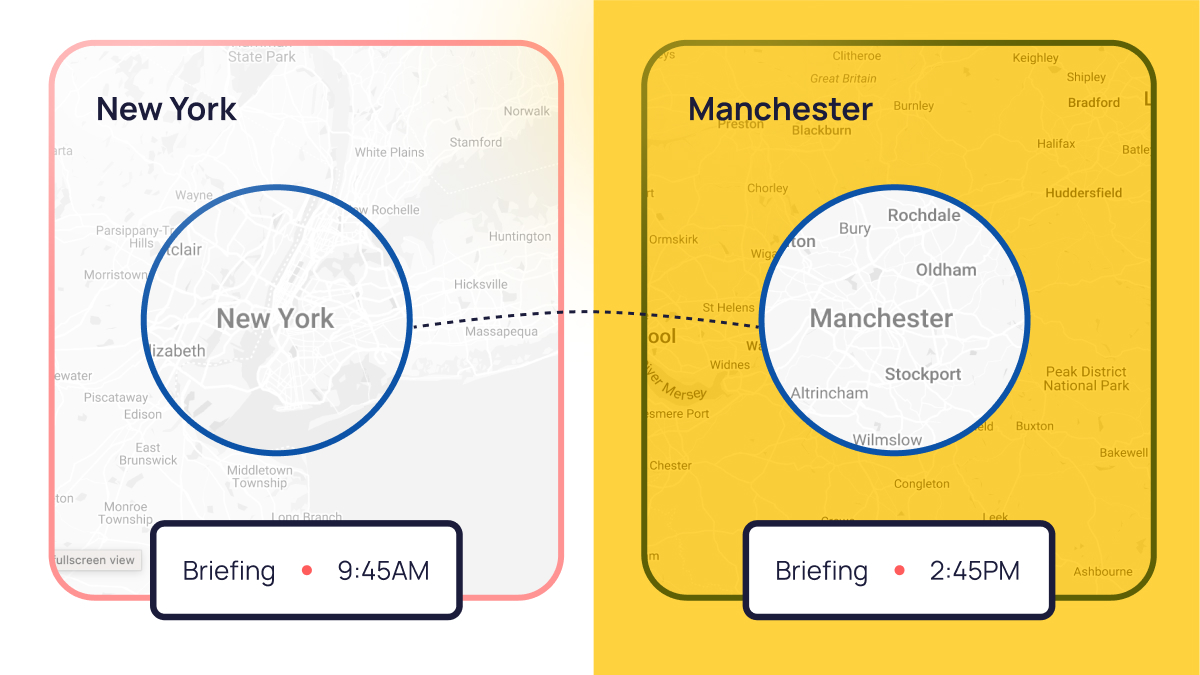
The five-hour gap to New York is an advantage, not a cost, and it’s the single most common thing US prospects raise before they start.
The worry is understandable. Nobody wants to send feedback at 4pm ET and wait a day for a reply. But that assumes the working day is the unit of collaboration, and on design projects it isn’t. The unit is the round.
The overnight round
We call it the overnight round: you brief or send feedback at the end of your day, our team works on it while you sleep, and the next version is waiting when you open your laptop.
That’s not a workaround we invented to explain away the time difference. It’s how we deliberately run US projects. You finish at 6pm ET on Tuesday having sent notes on version one. By 9am Wednesday, version two is in your inbox and you’ve lost no working time at all. Compare that to a local agency, where you send feedback at 6pm and they start on it at 9am the next morning, in your time zone, and you see it late afternoon.
Over a two-week project with four or five rounds, that gap compounds into days. US clients who’ve run both models notice it quickly.
When you actually want a live call
Live conversation matters at two points: the initial brief and any moment where the strategy shifts.
We schedule those in your morning, which is our afternoon. It’s a comfortable overlap for both sides, no one is dialling in at 10pm, and it means the day’s work has already happened by the time we speak. For everything else, written updates and shared files do the job better than a meeting would.
How a global presentation design agency runs a project
Three stages: a kick-off call, design rounds, then build and delivery. The only thing distance changes is when each handoff lands in your day.
The kick-off call
Every project starts with a kick-off call. No exceptions, and no working from a written brief alone.
Written briefs are useful, and we’ll always want the assets and background in writing, but a document can’t be interrogated. The call is where we find out what the deck is actually for, who’s in the room, what the audience already believes, what’s happened before, and what a good outcome looks like. That’s also where we push back if the brief is pointing in the wrong direction, which is easier to do live than over email. If you want to arrive well prepared, our guide on how to brief a presentation design agency covers what to bring.
The call gets scheduled in your morning, our afternoon. From there, most projects run in writing.
Design rounds and feedback
Design rounds are shared for review and feedback comes back however suits your team: email, Slack, Teams, or comments directly on the work. One thing genuinely matters more across time zones than it does locally, and it’s this: consolidated written feedback from a single owner beats five separate opinions arriving over two days. Get everyone’s notes into one place before you send them and every round moves faster.
Build and delivery
Once the design is signed off it goes into build, and that’s when PowerPoint versions start landing with you.
You get native, editable files your team can pick up after we’ve gone: PowerPoint as standard, plus Google Slides, Figma Slides or PDF exports depending on what your stack runs on. We build in the software you’ll actually present from, not in a design tool that produces something beautiful and untouchable.
Currency, contracts and pricing
Proposals and invoices are issued in your currency, so US clients see USD from the first quote to the final invoice.
Contracts are short and written in plain English. Rates are the same for US and UK clients: no international surcharge, no currency loading, no surprise line items. Pricing is driven by scope and speed, which means the size of the deck, the complexity of the content, and how fast you need it, not by where your office is.
What to look for in a global presentation design agency
Judge an overseas agency on the same five things you’d judge a local one, and add one.
Portfolio relevance. Not just whether the work looks sharp, but whether there’s anything close to your sector or your situation. A studio that has designed 40 investor decks is a different proposition to one that mostly does event graphics.
Process clarity. Ask them to walk you through a project start to finish. If the answer is vague, the project will be too.
Response speed before you’ve paid anything. How quickly they come back during the enquiry stage is the most reliable signal you’ll get about mid-project behaviour. This matters more, not less, across time zones.
Strategic pushback. The agencies worth hiring will challenge a weak brief and ask about the audience before they ask about the brand palette.
And the extra one: market fluency. Ask how they’d approach a deck for your specific audience. A US Series B pitch and a UK growth round are structured differently, weight the numbers differently, and use different language. Any agency working internationally should be able to explain that difference without being prompted.
The takeaway
Working with a global presentation design agency from the US isn’t a compromise you make to save money. It’s a wider choice of talent, a working night shift you didn’t have to hire, and a process that was already remote whether you noticed or not.
The question isn’t whether the agency is near you. It’s whether the work is good, the process is clear, and the people are sharp enough to make your presentation land. If you’d like to see how we’d approach yours, take a look at our pitch deck design agency work or book a discovery call and we’ll talk it through in your morning, our afternoon.
FAQs
Can a US company hire a UK presentation design agency?
Yes. Around 50% of Hype Presentations’ clients are US based. The practical differences are minor: calls are scheduled in the US morning, work is delivered overnight, and proposals and invoices are issued in USD. Contracts and pricing are the same as for UK clients.
How do time zones work with an overseas presentation design agency?
They work in your favour on design projects. Briefs and feedback sent at the end of the US working day are actioned overnight, so the next version is ready first thing the following morning. Calls are scheduled in the US morning, which is the UK afternoon.
Will an overseas agency understand a US audience?
It depends on the agency, so ask directly. A US investor deck and a UK one differ in structure, tone and how the numbers are weighted. Any agency working internationally should be able to explain those differences before you brief them.
What currency do overseas presentation design agencies invoice in?
Hype Presentations issues proposals and invoices in the client’s own currency, so US clients see USD throughout. Rates are identical for US and UK clients, with no international surcharge.
How long does a presentation design project take?
A single polished deck typically takes five to 10 working days depending on scope and slide count. Rush turnarounds are possible, and the overnight round means US clients often see progress a day sooner than they’d expect.